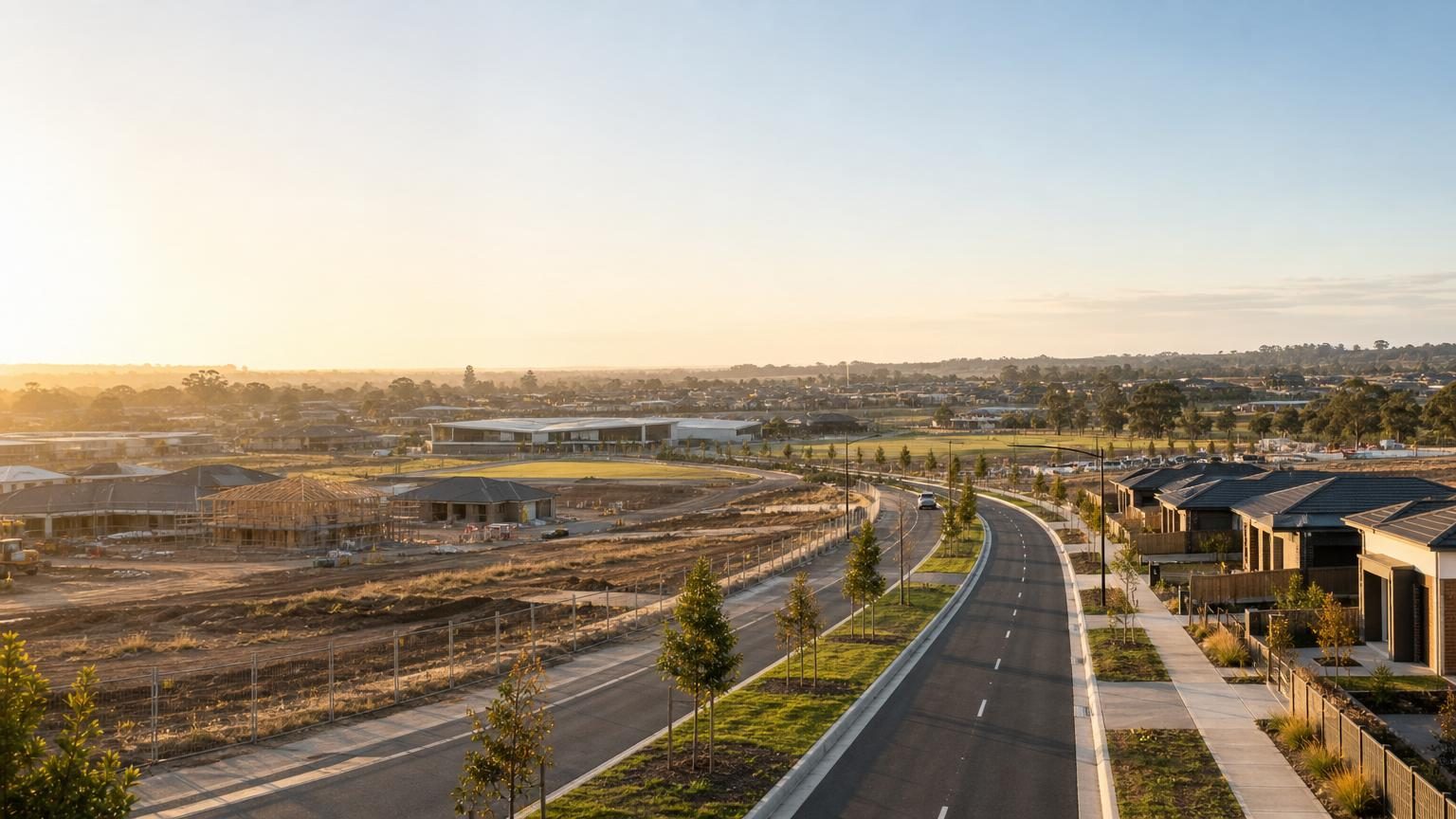
Land supply pressure makes certainty a sales asset for builders
Written by Hoome - Editor
Builders competing in land-constrained markets have a sharper commercial problem than low enquiry volume. A buyer may still want a new home, but if the path to a titled block, a suitable corridor or a realistic start date looks vague, that buyer can drift to an established home, a competing estate or a builder that explains the next step with more confidence.
That changes the job of local marketing. It is no longer enough to promote choice, value and lifestyle. The campaign has to reduce uncertainty before the buyer fills in a form, particularly in growth corridors where demand is visible but build-ready options can be thin.
Supply pressure is showing up in the numbers
The Housing Industry Association has put the national shortage in plain terms. HIA estimates Australia needed to build more than 250,000 homes last year to keep pace with demand growth and start reducing the housing shortage, yet construction commenced on just 196,000 homes.
That gap is not only a policy problem. It flows into sales rooms and enquiry pipelines. Population growth keeps adding household demand, while infrastructure, planning and investment barriers can slow the release of land that buyers can understand and act on.
For project builders, the result is a market where demand does not always convert cleanly into deposits. A family may have borrowing capacity, urgency and a preferred suburb, but still lack a clear answer to a basic question: where can this home actually be built, and when?
Buyers are filtering for build-readiness
In a looser land market, a buyer could browse designs first and solve the block later. In a constrained market, the sequence often reverses. Buyers start with location, title timing, estate availability, school access, transport links and the likelihood that a package will still be there when finance is ready.
This makes vague campaign language more expensive. Phrases such as “house and land available” or “build in Melbourne’s north” do little if the landing page does not show corridor options, availability status, expected timing or a useful way to register interest when stock is limited.
Buyers also become more sensitive to proof. They look for recent local builds, estate familiarity, sales consultant knowledge and clear process steps. If those signals are missing online, many will not wait for a call back to discover them. They will keep searching.
The pressure shifts from enquiry volume to enquiry quality
Land constraints can hide waste inside a healthy lead count. A campaign may generate forms from buyers attracted to price points or designs, only for the sales team to discover that the preferred suburb is unavailable, title timing is wrong, or the buyer has no appetite for a nearby corridor.
That is a conversion problem before it is a media problem. Paid search costs can become less forgiving when ads send buyers to broad design pages that do not answer land questions. Sales teams then spend more time qualifying mismatched enquiries and less time progressing buyers who understand their options.
The better commercial move is to make certainty visible earlier. Local landing pages should explain the realistic build areas, not just the aspirational ones. If titled land is scarce, say what pathways exist: waitlist, upcoming releases, alternative estates, knockdown rebuild options where relevant, or a consultation focused on matching budget to corridor.
Market the next step, not just the home
For marketing managers, the highest-value content is often the content closest to the buyer’s hesitation. A corridor page that explains which estates suit first-home buyers, which areas have larger blocks, and what timing questions to ask can outperform a generic suburb page because it helps the buyer feel less exposed.
The sales process needs the same discipline. Enquiry forms can ask about preferred locations, timing flexibility and whether the buyer has land. Follow-up should then reflect those answers, with a clear pathway rather than a standard brochure sequence. A buyer waiting for land release needs different nurture from a buyer holding a titled block.
This is where builder marketing can protect margin as well as lead flow. When buyers understand scarcity, timing and trade-offs before the appointment, consultants can spend less time resetting expectations. The conversation moves towards fit, budget and commitment, rather than correcting assumptions created by thin campaign pages.
Supply constraints will not be solved by better marketing. But builders can lose or win committed buyers in the gap between demand and certainty. In land-constrained markets, the builder that explains build-readiness first gives the sales team a better chance of holding the buyer long enough to reach a decision.